What do trusts need to help them to deliver the 2025/26 financial reset?
27 August 2025
On 6 March 2025, NHS England (NHSE) chief executive Sir James Mackey, wrote to trust and integrated care boards (ICB) leaders that their initial financial plans indicated a £6.6bn aggregate deficit. This triggered an immediate "financial reset".
The initial 2025/26 planning gap reflects the intense financial pressure the NHS has faced since beginning its recovery from Covid-19, and which was building ahead of the pandemic. Over the past three years, system finances have weakened, relying increasingly on national top-ups and trusts' ability to deliver record-breaking efficiency savings.
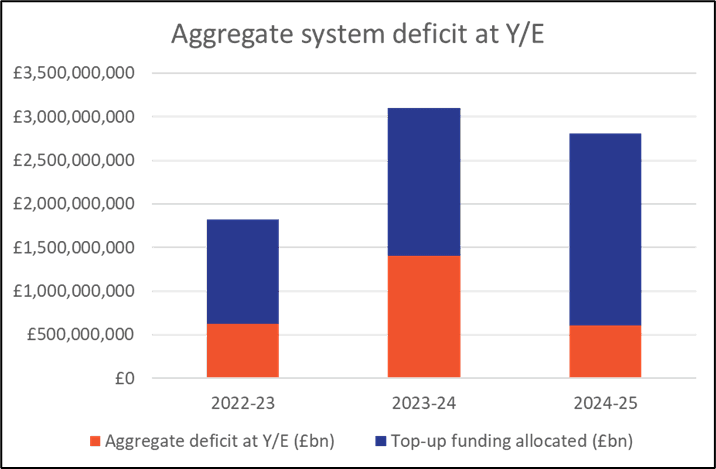
Although striking, the £6.6bn gap was similar to last year's initial planning gap. Between 2022/23 and 2023/24, the combined system deficit rose from £621m to £1.4bn, with more than half of systems ending the year in deficit.
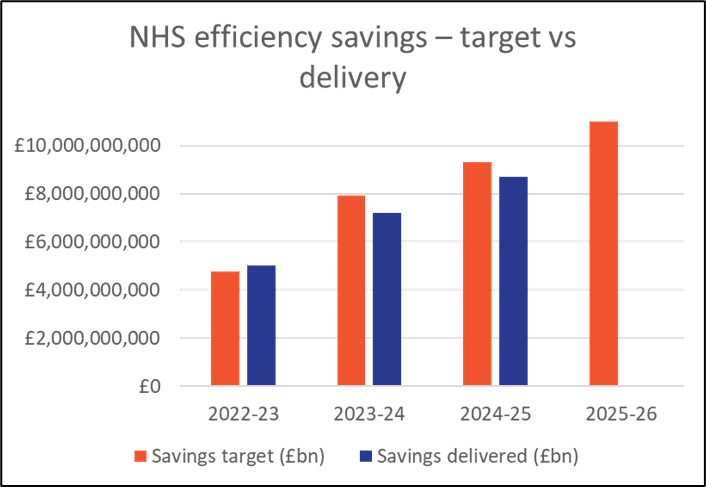
Last year, trusts and systems were tasked with delivering £9.3bn of efficiency savings, equal to 6.1% of their total funding allocation – the highest ever efficiency challenge.
In recent years there have been several persistent pressures on trust finances:
- Inflation – high inflation eroded the value of budgets agreed at the October 2021 Spending Review. The Office for Budget Responsibility reported that inflation (measured by the GDP deflator) over the 2022/23 financial year was 6.8% and was 6.1% over 2023/24, far above the planning assumptions of 4.4% for 2022/23 and 2.5% for 2023/24. NHS England (NHSE) estimated that this gap created an unfunded pressure of £1.7bn.
- Industrial action – NHSE has estimated that the total cost of industrial action over the 2023/24 financial year was £2.4bn. This was partially covered by £1.7bn of funding injected during the financial year to cover the direct cost of industrial action (for example costs of covering overtime payments). Crucially, this did not cover the indirect costs incurred by trusts (for example, lost elective income) and the disruption it caused to delivering business-as-usual activity.
- Surging expectations of technical efficiency savings – as Figure 1 demonstrates, savings targets have more than doubled between 2022/23 and 2025/26. Trusts have achieved impressive and significant year-on-year increases, but the targets have risen more rapidly than trusts have been able to deliver.
Figure 1: Post-pandemic NHS efficiency savings
- Operational pressures reducing productivity – service delivery pressures often drive costs up, for example by pushing trusts to outsource to the independent sector to cut waiting lists, or run extra sessions staffed by bank or agency workers. Systemic issues, like higher patient acuity, longer stays, and delays in discharging patients with no criteria to reside, continue to make it more difficult to deliver productivity gains.
Combined, these pressures have resulted in an increasingly challenging financial task for trusts and systems each year. To help tackle this, NHSE has repeatedly allocated additional resources – often sourced by redeploying vital transformation budgets – but this masks the true scale of the underlying deficit.
£1.2bn of top-up funding was provided in 2022/23 and over £1.7bn in 2023/24. As Figure 2 makes clear, the true underlying post-pandemic deficit is far larger than final year-end figures suggest – helping to explain the initial £6.6bn planning gap in 2025/26.
Figure 2: Post-pandemic aggregate system deficit (including allocated top-up funding)