
Towards integrated health organisations: considerations for policy and NHS leaders
Agreeing the contractual form
A contract for a geographically defined population
The distinguishing feature of an IHO is its capitated contract, which provides a single budget to cover healthcare services for a whole population. Unlike other available contracts, IHO contracts cover the provision of all healthcare services for that population, excluding the public health functions that local government is responsible for, 2 and services better commissioned at scale (either at an ICB, regional or national level), such as highly specialised care services. Other contractual forms are available for specific patient cohorts or service areas, such as Year of Care payments which were proposed in the 10YHP. 3
The ICB is responsible for awarding the contract, overseeing its delivery and analysing population health data to help inform sub-contracting decisions by the IHO host provider. Where no IHO host provider exists, the ICB will continue to commission services directly from providers.
The IHO host provider then provides some services directly and provides necessary sub-contractual arrangements for other services to appropriate providers. For example, a hosting community trust might sub-contract upstream to primary care or an acute trust might sub-contract downstream services. The contractual form will vary, drawing on the options defined in the NHS Payment Scheme. These include blended payments (including payment by activity), single- and multi-neighbourhood provider contracts (see more on this below), Year of Care payments and capitated sub-contracts that delegate responsibility for a subset of the population.
The host provider could sub-contract population health responsibility or service delivery to one organisation. Given that many providers operate across multiple geographies, it is possible that a single organisation may hold an IHO contract for one geographical population, act as a sub-contractor in another, and be part of a non-IHO system in a third. Assurance will need to be provided that the IHO contract is robust, provides financial value, and contains a clear allocation of risk and reward. 4
Strategic commissioning
IHO host providers will need strong strategic commissioning skills to effectively sub-contract services for their populations. Strategic commissioning differs from traditional commissioning in that it seeks to achieve a more proactive, data-driven and collaborative health service. This shift will require a transfer of expertise from the ICB to the IHO host provider, along with a redrawing of the traditional commissioner/provider boundary.
As the NHS Confederation set out in our vision of ICB strategic commissioning, strategic commissioning requires five core capabilities:
- Data analysis skills and digital capability to understand population health and plan proactive care
- Diplomatic skills to convene providers and facilitate collaboration
- System leadership skills to build cohesive teams across organisational boundaries
- Contract management expertise to manage contract performance and transform models of care
- Estate management capabilities to maximise the value from the available estate of all system partners.
Host providers will need capacity and capabilities in all these areas, alongside robust evaluation skills to understand the efficacy of sub-contracted services. They will also rely on ICBs’ analysis of population health need; regional commissioning of highly specialised services; and to co-ordinate with local government commissioned social care and other services, such as public health and housing. These relationships will be crucial to enabling IHOs to deliver the transformational shifts envisioned in the 10YHP.
Examples of similar models
The host provider and sub-contracting model aims to reduce competing incentives by aligning financial flows and outcomes across providers. It should provide a gain/loss share mechanism, ensuring all providers along a care pathway have a shared financial incentive to deliver care earlier and avoid downstream admissions. That is, if an upstream provider successfully prevents hospital admissions, all providers along the pathway benefit financially. See figure 1.
International health systems have successfully used host providers with capitated contracts to shift care to community settings and deliver better value. In the US, Medicare awarded a capitated contract to ChenMed, a primary care provider, to deliver and sub-contract services for people over 65 in Miami. 5 ChenMed assumed financial risk, covering any deficits but retaining any surplus from avoided secondary admissions. In this arrangement, ChenMed was essentially the IHO host provider, with Medicare functioning as the strategic commissioner. The financial flow incentivised the shift of resources from sickness to prevention and from hospital to community care, nearly halving average hospital inpatient days for over-65s compared to both the rest of Miami and to average admissions in England.
Figure 1
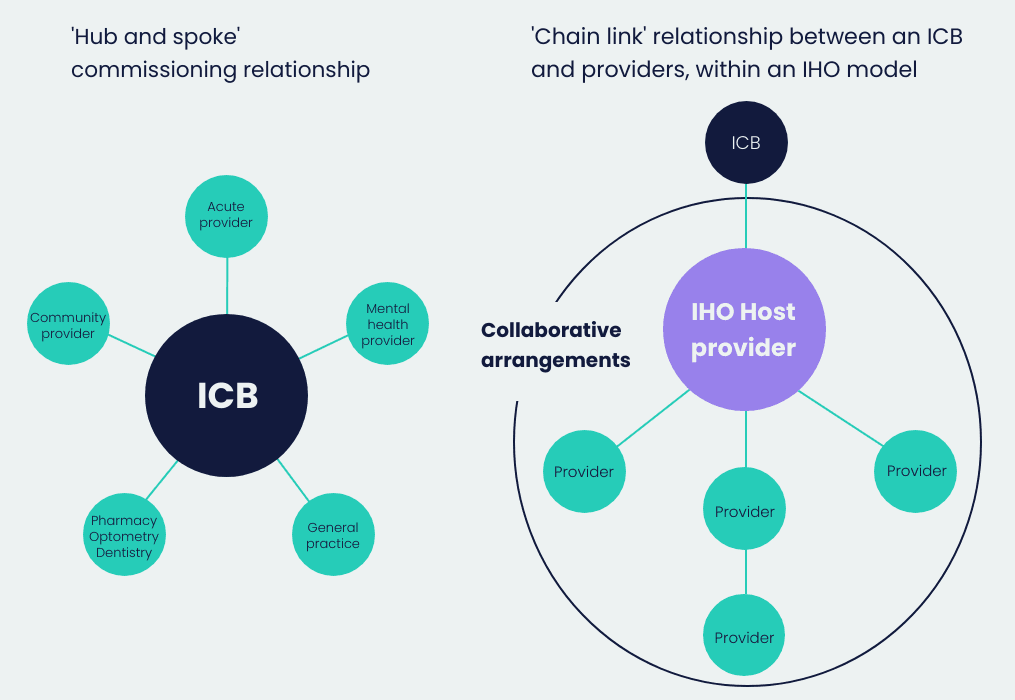
Figure 1 Left: a typical ‘hub and spoke’ commissioning relationship between an ICB and providers. Right: a ‘chain link’ relationship between an ICB and providers, with an IHO establishing a link to align the financial flow and straddling the ‘purchaser-provider’ split. Collaboration between the providers is re-enforced by a structural relationship.
Barriers
Procurement of services and contract management places an additional administrative burden on the host provider. As NHS England has required all NHS trusts and foundation trusts to reduce the growth in their corporate spend since 2018/19 by 50 per cent, there is a risk that foundation trusts may lack sufficient administrative capacity to take on the commissioning functions that come with being a host provider. 6
Competition concerns may arise for IHO host providers particularly where they will be responsible for commissioning services that both they, as a provider, and other providers in their area may be able to deliver.
Competition concerns and potential breaches could arise in several ways. Firstly, in terms of the procurement process undertaken by the host provider for subcontracting arrangements, which currently must comply with the requirements of the Health Care Services (Provider Selection Regime) Regulations 2023. Secondly, where the host provider can be said to have a dominant position in the market which allows it to unfairly restrict competition whether in its own market or in the downstream market, which may amount to a breach of Chapter 2 of the Competition Act 1998 (CA98). Thirdly, where providers within a collaborative are sharing information that affects competition, which may amount to a breach of Chapter 1 of the CA98. Additional considerations may apply under the merger control regime set out in the Enterprise Act 2002 where providers are coming under joint control.
To avoid competition law being a barrier to IHOs, the Department of Health and Social Care should liaise with the Competition and Market Authority and, if necessary, use the upcoming NHS reform bill to disapply certain aspects of competition law to the NHS and/or where IHO contracts have been awarded.
The relationship between IHO and neighbourhood health contracts
Alongside IHO contracts, the 10YHP introduces two new neighbourhood provider contracts. The ‘single neighbourhood provider’ (SNP) contract maps onto the primary care network (PCN) population footprint of 30,000-50,000 to deliver joined-up, enhanced neighbourhood care. The second type, ‘multi-neighbourhood provider’ (MNP) contracts, will be used to deliver care across more than one neighbourhood, covering populations of 250,000 or more. Both aim to unlock the benefits of working at scale through joined-up corporate infrastructure, data analytics and quality improvement infrastructure.
IHOs and new neighbourhood contracts should perform different, but complementary, roles: the IHO contract shifting resource towards neighbourhoods and the neighbourhood contracts overcoming fragmentation in the delivery of out-of-hospital care. Mapping SNP footprints to MNP footprints, and then MNP footprints to IHO footprints, will be essential for ensuring coterminosity, so ICBs can set outcomes consistently at all scales.
In some areas, particularly where there is no at-scale primary care organisation, an IHO host provider could sub-contract neighbourhood care through the SNP and MNP contracts within its population. While the expectation is for neighbourhood contracts to start to be rolled out in 2026, the government’s plan is for a small number of IHOs to become operational in 2027.