
State of the provider sector
Financial sustainability and productivity
Confidence in financial plan delivery
FIGURE 7
How confident are you that your trust will deliver its financial plan for 2025/26?
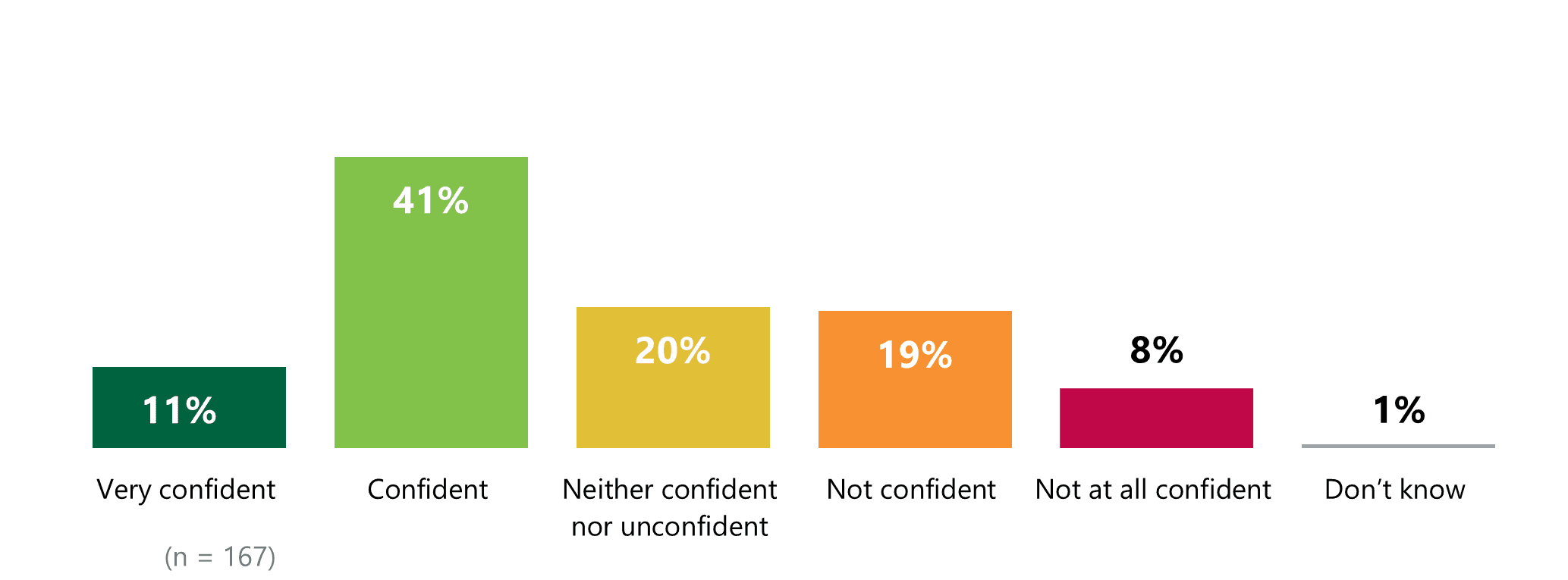
- Around half (52%) of those we surveyed were confident that their trust will deliver its financial plan for 2025/26. 20% were neither confident nor unconfident. 28% were not confident their trust would deliver its financial plan for 2025/26.
- Confidence in meeting 2025/26 financial plans varied widely by trust type: ambulance and community trusts were more confident about meeting financial plans for 2025/26 than the survey average, whereas acute and combined acute and community trusts were less confident.
Efficiency savings rates
FIGURE 8
Do you think your trust's 2025/26 planned efficiency savings rate is deliverable?
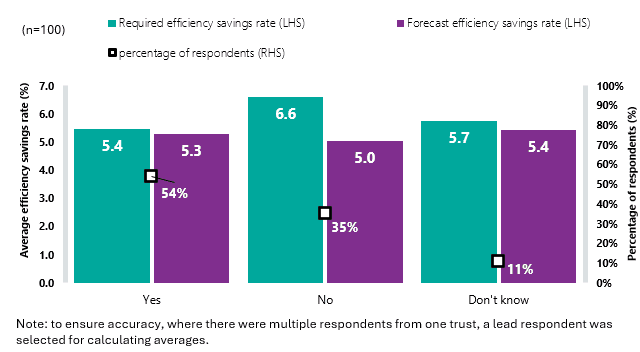
- The sample of trusts we surveyed are required to deliver an average 5.9% efficiency savings rate in 2025/26, but forecast achieving only 5.2%, leaving a 0.7 percentage point gap.
- 54% of respondents believe their target is deliverable, with a small gap (0.1 percentage points) between required and forecasted rates.
- 35% do not believe their target is achievable, facing higher required rates (6.6%) and a larger gap (1.6 percentage points) with forecasted rates.
- 11% are unsure, with a gap of 0.5 points between required and forecasted savings.
- Reasons provided for the gap included being compelled to agree to unrealistic plans, challenges finding recurrent savings, high levels of demand, a slow pace of change, reduced turnover and a lack of redundancy funding.
We are already in the lowest cost quartile of the model hospital with a huge gap between demand and our capacity to meet demand. It is not obvious where there is waste that leads to cash savings as opposed to closing the capacity gap.
Very challenging to find recurrent cost reductions. There are a lot of one-off / non-recurrent actions being taken to try and meet the in year challenge, but we are not delivering significant transformation that is leading to cost reductions.
Actions to help manage or improve financial position
FIGURE 9
Is your trust currently taking any of the following actions to help manage or improve its financial position this year?
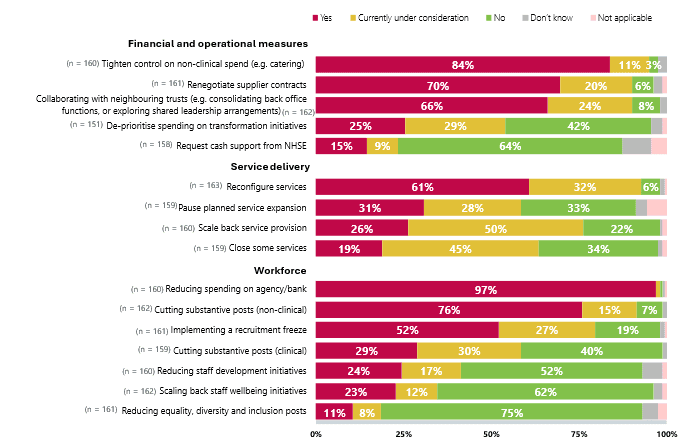
- Workforce: 97% of trust leaders are cutting agency and bank spend. Many are reducing non-clinical posts (76%) but cuts to substantive posts are less common (29%). Over half are implementing recruitment freezes (52%).
- Financial and operational measures: Most trusts are tightening control on non-clinical spend (84%), renegotiating supplier contracts (70%), and collaborating with neighbouring trusts (66%).
- Service delivery: 61% are reconfiguring services, while fewer are scaling back provision (26%) or closing services (19%).
Initiatives that have had a major impact on increasing productivity
FIGURE 10
Which initiatives have had a major impact on increasing productivity within your organisation this year?
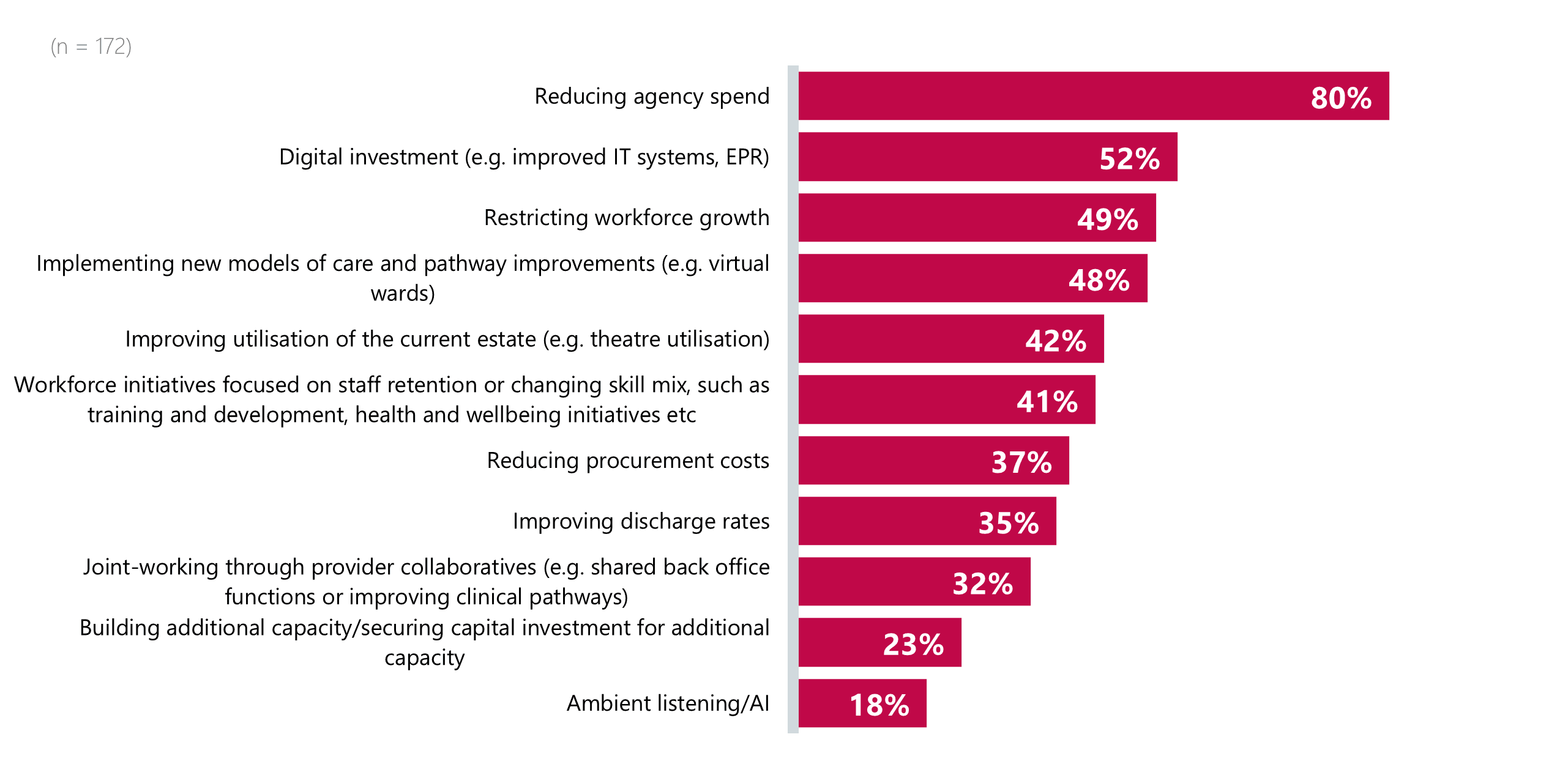
- Agency spend reduction is increasingly seen as a key productivity driver, with 80% of respondents citing that it has had a major impact this year, up from 55% in a survey on finance we ran in April 2024.
- Other initiatives that have had a major impact on increasing productivity include digital investment (52%), restricting workforce growth (49%), and implementing new care models and pathway improvements (48%).
- Ambient listening/AI has had a more limited impact so far, with 18% selecting this option.