
NHS Activity Tracker: September 2025
Acute
236,260
patients on 28-day FDS cancer pathway seen within standard in July
35,900
patients waiting more than 12 hours from decision to admit to admission in A&E
2.61m
diagnostic tests carried out in July
Accident & Emergency (A&E) (August 2025)
A&E attendances
-
There were 2.27 million A&E attendances this month, the highest August on record, up by 5% compared to last August.
-
Over three-quarters (75.9%) of patients were seen within four hours. Performance dipped below last year (76.3%) highlighting the ongoing strain across UEC. As we move into winter, the UEC delivery plan sets out a performance aim of 78%.
A&E emergency admissions
-
There were 526,400 emergency admissions in August, with little change from this time last year.
12-hour waits in A&E from decision to admit to admission
-
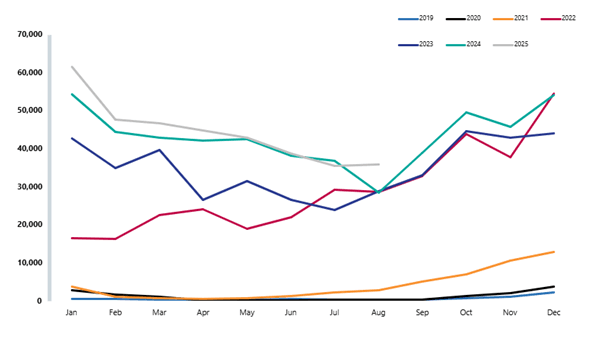
In August, 35,900 patients waited at least 12 hours from the decision to admit to admission. This is the first time the figure has increased since the January peak of 61,500. It is currently 26% higher than last year and is nearly 100 times higher than pre-pandemic levels (see figure 1).
12 hours in an emergency department (ED) from arrival
-
122,560 patients waited more than 12 hours from arrival at A&E in August. This figure has fallen from a high of over 176,000 seen in January but highlights that too many patients are facing long delays.
-
The UEC delivery plan outlines an aim for fewer than 10% of patients waiting over 12 hours in A&E over winter. Waits of over 12 hours occur 8.9% of the time currently, but based on performance in previous years, this will be challenging to maintain over winter.
Figure one
Number of patients spending >12 hours from decision to admit to admission
Acute discharge delays (August 2025)
-
The proportion of patients remaining in hospital at the end of each day despite no longer meeting the criteria to reside was 56.6% - the highest proportion since March 2025.
Cancer (July 2025)
-
Monthly activity across all three pathways (28-day faster diagnosis standard, 31-day and 62-day) was the highest on record in July.
-
A record 236,260 patients with an urgent referral were told they have cancer, or if it was excluded, within 28 days in July. Despite a record high number of checks, the proportion of all patients seen within the standard (76.6%) dipped slightly compared to last month (76.8%), reflecting high levels of overall demand and activity. The proportion is up compared to last year (76.2%), but there is further to go to meet the planning guidance target of 80% by March 2026.
-
57,260 patients were seen within the 62-day standard this month, which is a record high. This is equivalent to 69.2% of patients on the 62-day pathway being seen within the standard, higher than last year (67.4%) and a step in the right direction towards the planning guidance target of 75% by March 2026.
Diagnostics (July 2025)
-
In July 2025, 2.61 million diagnostic tests were carried out – the highest figure on record.
-
Despite climbing activity, the waiting list held steady at 1.73 million in July. This represents an increase of over 60% compared to before the pandemic, highlighting ongoing pressure on diagnostic services.
-
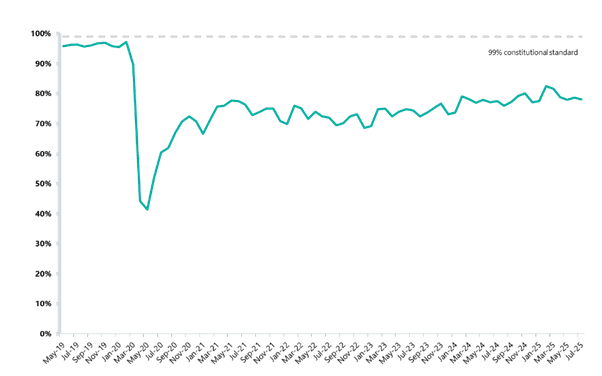
In July 2025, 78% of patients were seen within six weeks for diagnostic tests, an improvement since last July (77.6%), but performance has generally been moving further away from the 99% constitutional standard since the start of this year (see figure 2).
Figure two
Percentage seen within six weeks for diagnostic tests and procedures
Elective waiting list (July 2025)
-
The size of the waiting list increased slightly for the second month running to 7.4 million in July. This is 3% smaller than last year but remains significantly elevated compared to before the pandemic (64% larger than six years ago).
-
In July, 84.4% of patients on the waiting list were unique patients. This is an estimated 6.25 million people.
-
The number of treatments waiting more than 18 weeks was 2.87 million, falling by 9% compared to last year. Waits over 18 weeks are equivalent to 61.3% of all waits, with progress needed to meet the planning guidance sets aim for 65% of treatments to be waiting no longer than 18 weeks by March 2026.
-
Waits of over 52 weeks (191,650) are down by 34% compared to last July and total 2.6% of all waits. The planning guidance sets out an aim for waits over a year to account for 1% of all waits by March 2026.