NHS Activity Tracker: July 2025
Acute sector
75.5%
of patients seen within 4 hours in A&E in June
36%
fall in waits over 52 weeks for planned treatment compared to last year
2.47m
diagnostic tests carried out in May
Key points
-
Despite the busiest June on record for A&E attendances, this month saw a stronger performance against the four-hour target than the last three years. However, further progress is necessary to meet the aims for winter preparedness set out in the UEC delivery plan.
-
Indicators of patient flow within hospitals, such as discharge delays and 12 hour waits related to A&E, remain stretched but show signs of gradual improvement.
-
In planned care, cancer activity remains high across all pathways, and we saw the highest May figure on record for diagnostic activity completed by trusts. But demand continues to outpace capacity, and performance has been gradually slipping back against key targets in diagnostics and cancer care, signalling ongoing delivery pressures.
-
The elective waiting list dipped again in May to the smallest it has been in over two years. However, the diagnostic waiting list, which is a subset of the elective list, reached a record high, highlighting strong demand for diagnostic tests and procedures.
-
For the first time, elective waiting list data has been published by characteristic, including age, sex, ethnicity and deprivation decile. We explore the key findings from this data below.
A&E
-
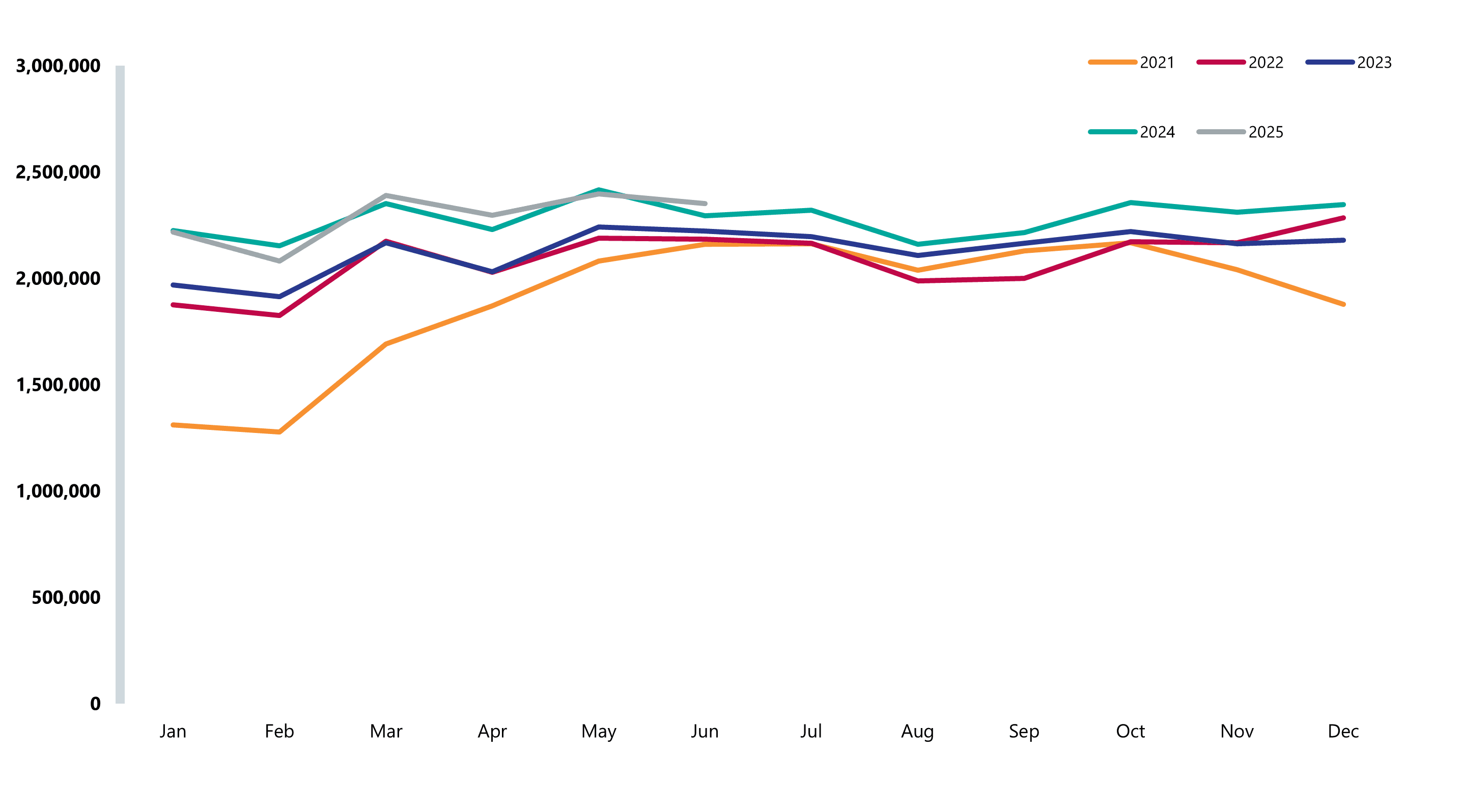
There were 2.35 million A&E attendances this month, the highest June on record. Demand in the first half of 2025 is closely mirroring the same period in 2024 (see figure 1).
-
Despite high demand, this month saw the strongest June performance since 2021: three-quarters (75.5%) of patients were seen in four hours. The UEC delivery plan outlines this as one of the key areas of focus for winter preparedness, with a performance aim of 78%. You can read our summary of the delivery plan for recovering UEC services here.
-
In June, 36,680 patients waited at least 12 hours from the decision to admit to admission. While this figure has been gradually declining each month since the January peak of 61,500, it remains over 80 times higher than pre-pandemic levels.
-
121,860 patients waited more than 12 hours from arrival at A&E in June, down from highs of over 176,000 seen in January.
-
The UEC delivery plan outlines this as one of key areas to deliver against for winter preparedness, aiming for less than 10% of patients waiting over 12 hours in A&E. Currently waits of over 12 hours occur 8.8% of the time, but this will be a challenge to maintain over winter, based on performance in previous years.
Figure 1
Number of A&E attendances per month
Acute discharge delays
-
The proportion of patients remaining in hospital at the end of each day despite no longer meeting the criteria to reside was 54.9% in June;, this is the first time in 13 months that this measure is lower than the previous year.
Elective waiting list
-
The size of the waiting list dipped slightly to 7.36 million in May, which is the smallest it has been in over two years (since March 2023). It remains 64% larger than six years ago, before the pandemic.
-
In May, 84.6% of patients on the waiting list were unique patients. This is an estimated 6.23 million people.
-
The number of treatments waiting more than 18 weeks fell by 235,000 (-8%) from 2.87 million treatments last year, equivalent to 60.9% of all waits. The planning guidance sets out an aim for 65% of treatments to be waiting no longer than 18 weeks by March 2026.
-
196,920 treatments had been waiting over 52 weeks in May, down by 36% compared to last year and totalling 2.7% of all waits. The planning guidance set out an aim for waits over a year to make up 1% of all waits by March 2026.
Elective waiting list characteristics
- This month NHS England released data on the characteristics of people with a case on the elective waiting list for the week ending 29 June 2025. Below, we examine how waiting lists vary by specialty across England and compare the characteristics of people on the waiting list to the general population.
Waiting lists by specialty in England
-
Trauma and orthopaedics has the longest overall waiting list in England, with 808,570 patients waiting, accounting for 11% of all waits. This is followed by other – medical services (11%) and ear, nose and throat (ENT) (8%).
-
For waits over 52 weeks, ENT has the highest proportion of cases (14%) followed by trauma and orthopaedics (14%) and gynaecology (9%).
Age
-
The proportion of cases waiting by age group is: 0-18 years (11%), 19-64 years (56%), 65+ years (33%). Compared to the population of England1 (0-18: 22%, 19-64: 60%, 65+: 18%), people aged 65 and over are notably overrepresented2.
-
Children and young people are most likely to be waiting in paediatric services (37% of child waits). Gynaecology has the largest waiting list for adults aged 19-64, accounting for 12% of adult waits. For those aged 65 and over, Ophthalmology (14%) and Trauma and Orthopaedics (14%) have the largest waiting lists.
Sex
-
57% of cases on the waiting list are for female patients, and 43% are for male patients. This compares to the national population1,2, where 51% are female and 49% are male.
-
For females, gynaecology has the highest proportion of waits across all specialties (13%), followed by trauma and orthopaedics (11%) and other - medical services (10%). For males, the longest waiting lists mirror the top three in England overall: trauma and orthopaedics (12%), other - medical services (11%) and ENT (9%).
Ethnic group
-
The proportion of waits accounted for by each ethnic group varies: white (79%), Asian (9%), black (4%), mixed (2%), other (1%), Chinese (0.4%). All ethnic group proportions are broadly in line with the equivalent proportion in the population of England1,2.
-
Other - medical services has the highest number of waiting list cases across all ethnic groups except white patients, for whom trauma and orthopaedics has the highest volume.
-
ENT has proportionately higher waiting list case volumes among patients with white, Asian, mixed, and other ethnic backgrounds. Gynaecology is similarly high for black, Chinese, and other ethnic groups. Ophthalmology also appears among the top specialties for black and Chinese patients.
-
For all ethnicities, ENT and gynaecology consistently account for some of the highest numbers of cases waiting over 52 weeks. Trauma and Orthopaedics has one of the longest lists of cases waiting over 52 weeks for patients of Asian, Black, Other and White ethnicity.
Deprivation
-
Cases on the waiting list have a broadly even distribution across deprivation deciles.
-
Trauma and orthopaedics and other – medical services have the longest waiting lists at both ends of the deprivation scale.
-
However, in some specialities, there is a higher share of cases waiting for those from the most deprived areas (decile 1) compared to the least deprived areas (decile 10). For example, cases waiting in decile 1 represent 11% of the gynaecology waiting list compared to only 7% in decile 10.
-
Cases waiting in the most deprived areas (decile 1) account for 12% of all waits over 52 weeks, while those in the least deprived areas (decile 10) account for 9%. Long waits are not only more common in deprived areas but are disproportionately represented in certain specialities including other – paediatric services, other – medical services, and gynaecology.
Notes
-
Data on the population of England by sex, age, and ethnic group are taken from the Census 2021.
-
A single patient may appear multiple times on the waiting list if they hold more than one case. Therefore, any over or underrepresentation of a characteristic on the waiting list relative to the general population may reflect not only the number of individuals with that characteristic, but also a greater likelihood of those individuals having multiple cases.
Cancer
-
Monthly activity across all three pathways (28-day faster diagnosis standard, 31-day and 62-day pathways) in May was broadly unchanged from the month before. Activity is now double 2019 figures for the 31-day and 62-day pathways (28-day FDS is not comparable to this time period).
-
In May, 74.8% of patients with an urgent referral were told they have cancer, or if it was excluded, within 28 days – the third consecutive month of slipping performance against this measure, and performance is below May last year (76.4%).
-
67.8% of referrals met the 62-day standard this month, a slight fall from last month but an improvement compared to last year (66.6%).
Diagnostics
-
In May 2025, 2.47 million diagnostic tests were carried out – the highest May figure on record.
-
Despite climbing activity, demand for diagnostic testing remains high and the waiting list for diagnostic testing has grown. After dropping back slightly last month, the waiting list rose to the highest number ever recorded, 1.71 million, up by over 60% compared to before the pandemic.
-
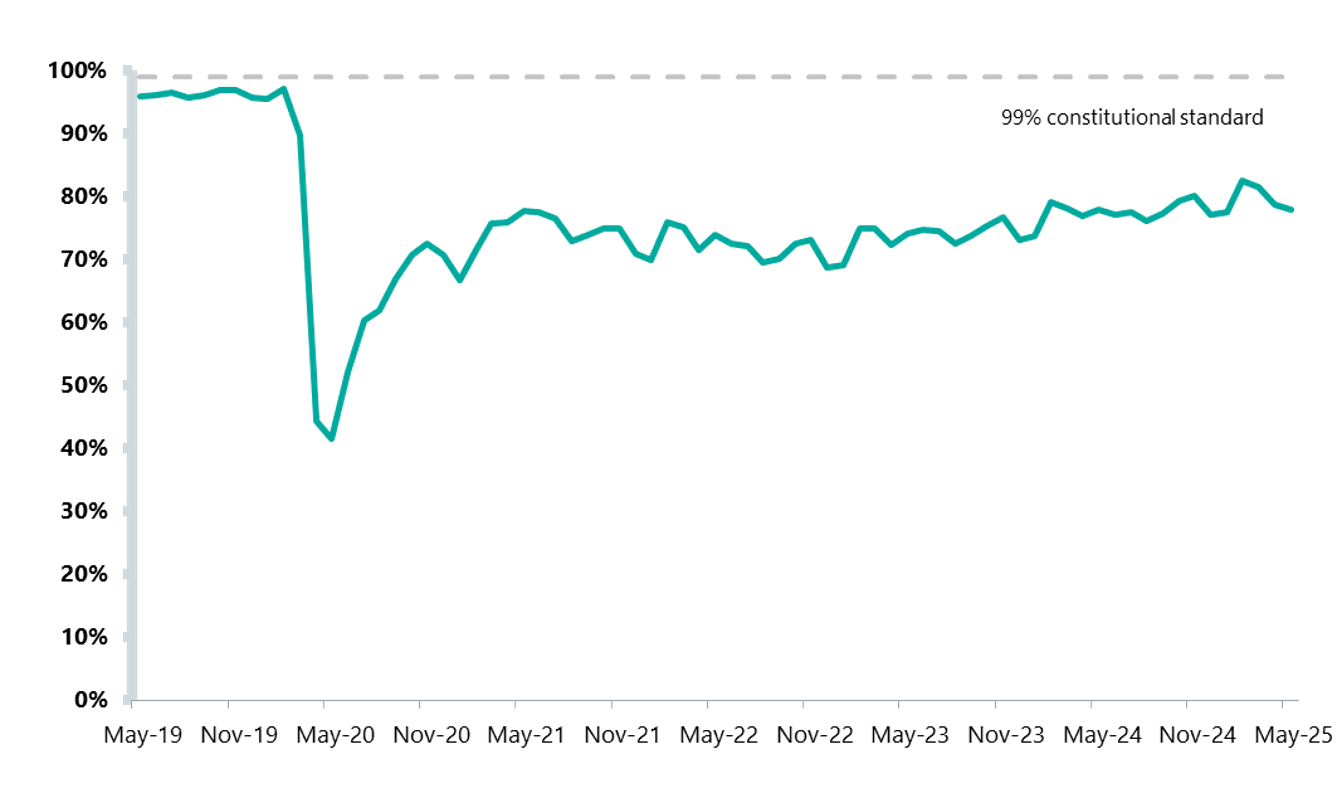
In May 2025, 78% of patients were seen within six weeks for diagnostic tests, with performance moving further away from the 99% constitutional standard.
Figure 2
Percentage seen within six weeks for diagnostic tests and procedures