
NHS Activity Tracker: January 2026
Winter
2,725
beds occupied each day due to flu in the first week of January
95.7%
of adult general and acute beds in hospitals occupied in the first week of January
13,445
patients on average per day remaining in hospital who didn’t meet the criteria to reside
This monthly publication will feature a compilation of NHS England's weekly sitreps throughout the winter period. We will monitor key activity and demand figures across the NHS, analysing key trends to better understand the pressure facing trusts this winter. The latest data released refers to week commencing 5 January 2026 (referred to as the first week in January).
Key findings
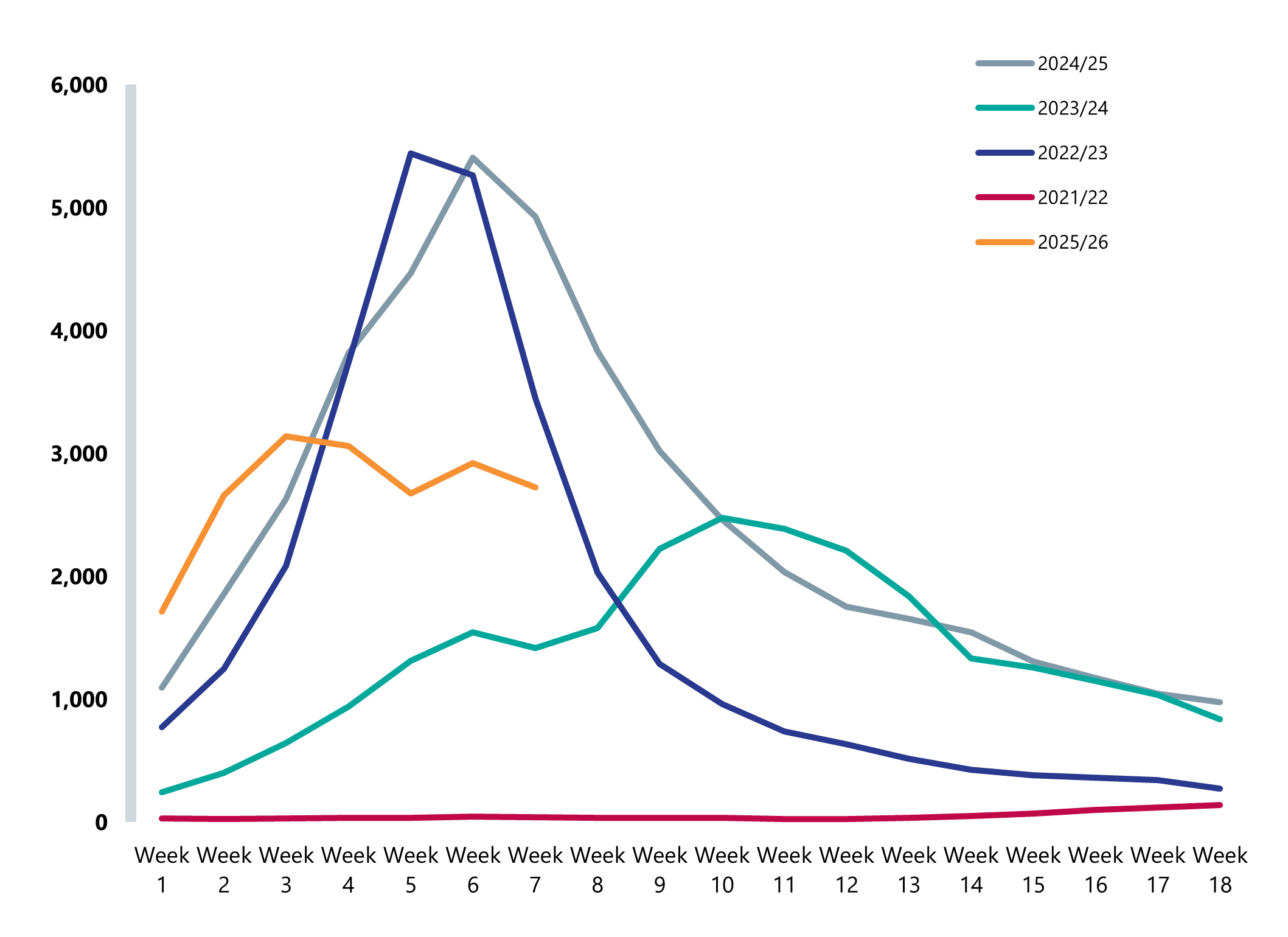
- Viruses and absences: At the start of this winter, flu was at record levels. However, from week commencing 15 December onwards, flu beds have been lower than 2024/25 and 2022/23. In the first week in January, 2,725 beds were occupied on average each day by flu patients, compared with 4,929 last year. In the first week of January, pressure was increasing from RSV and D&V, whilst Covid-19 remained stable compared to the week before.
- Beds and occupancy: Adult general and acute (G&A) bed occupancy was 95.7%, exceeding both NICE and NHS planning guidance targets, though it is slightly lower than last year. Paediatric intensive care occupancy (PICU) has generally been lower than last year, but the first week of January was slightly higher than in 2024. Adult critical care has been consistently lower than last year, and NICU occupancy has been consistently slightly higher than last year.
- Access and flow: A&E diverts, due to lack of capacity, are slightly lower than this time last year. A total of 690,719 patients have arrived at hospital by ambulance so far this winter, compared with 666,214 at the same point last year. Discharge delays remain significant, equating to 95,115 bed days lost in the first week of January this year.
Viruses and absences
Flu: The first three weeks of the winter sitrep (weeks commencing 24 November, 1 December and 8 December) saw more flu beds occupied by flu patients than the previous three years. However, from week commencing 15 December onwards, flu beds have been lower than 2024/25 and 2022/23. In the first week in January, 2,725 beds were occupied on average each day by flu patients, compared with 4,929 last year. This was a decrease of 7% compared with the week before. This is shown in Figure 7.
RSV: Paediatric beds closed for RSV reached a peak of 107 in week commencing 8 December and then decreased for several weeks, when it has remained largely consistent with the previous few years. However, RSV beds saw an uptick in the first week in January, with 88 beds were closed compared with 59 last year. This was an increase of 28% compared with the week before.
D&V: The number of adult beds closed due to D&V and norovirus-like symptoms reached a peak of 537 in week commencing 8 December before dropping to 389 the following week and then increasing again. In the first week in January, 640 beds were closed compared with 749 last year. This was an increase of 48% compared with the week before.
Covid-19: The number of beds occupied by Covid-19 patients is low compared to the last few years. In the first week in January, 656 beds were occupied by Covid-19 patients, compared with 1,112 last year. This was an increase of <1% compared with the week before.
Staff absences: Overall staff absences were broadly unchanged from last year until week commencing 29 December. The number of staff absent from work through sickness or self-isolation increased steadily until week commencing 15 December, but decreased sharply for week commencing 22 December before starting to increase again. In the first week of January, on average 53,955 members of staff were absent per day, compared with 54,856 last year. This was an increase of 3.9% compared with the week before.
Figure 5
Average daily number of beds (general, acute and critical care) occupied by flu patients
Beds and occupancy
G&A beds: In the first few weeks of December, adult general and acute (G&A) bed occupancy was consistently high (around 95%) but dropped around Christmas to a low of 88.7% in week commencing 22 December. With the exception of Christmas week, these rates remain above both the NICE 2018 guideline of 90% and the 2023/24 planning guidance target of 92%, but have so far been largely below the rates from last year. In the first week of January, G&A bed occupancy stood at 95.7% compared with 95.8% last year. This was an increase of 2.2% compared with the week before.
Critical care beds: The proportion of adult critical care beds that have been occupied has varied since the start of the winter sitrep, but has been consistently lower than it was last year. In the first week of January, it stood at 81.2% compared with 83.9% last year. This was an increase of 8.8% compared with the week before.
PICU occupancy: PICU bed occupancy has generally been lower than it was last year. However, in the first week of January it stood at 74.8% compared with 73.5% last year. This was an increase of 3.2% compared with the week before.
NICU occupancy: So far this winter, NICU bed occupancy has been consistently slightly higher than last year. In the first week of January, it stood at 69.5% compared with 67.6% last year. This was a marginal increase compared with the week before.
Access and flow
As highlighted in our acute and ambulance section, urgent and emergency care services continue to experience high demand which is also reflected in the winter sitrep data:
A&E closures and diverts: So far this winter, patients were diverted to other A&E departments 268 times due to a lack of capacity, three occurrences less than this time last year. There have been no A&E closures so far this winter.
Ambulance arrivals: In the first week of January, 97,161 patients arrived at hospital by ambulance. This takes the total so far this winter to 690,719 patients compared with 666,214 at the same point last year, an increase of 3.68%.
Ambulance handovers: The mean handover time dropped to under 26 minutes for weeks commencing 15 and 22 December, but if we calculate an average for winter so far without these weeks, the mean handover time is 33 minutes and 17 seconds. In the first week of January, the average handover time was 42 minutes and 48 seconds, compared with 41 minutes and 16 seconds last year. This is the longest average handover time so far this winter and is an increase of four minutes and 59 seconds compared with the week before.
Discharges: Throughout winter so far, on average one in seven hospital beds were occupied by patients medically fit to be discharged (13.6% of occupied beds). In the first week of January, an average of 13,445 patients remained in hospital who no longer met the criteria to reside per day, compared with 13,585 last year and 12,688 the week before. This equates to 94,115 bed days lost in the first week of January this year.