
NHS Activity Tracker: December 2025
Winter
This monthly publication will feature a compilation of NHS England's weekly sitreps throughout the winter period. We will monitor key activity and demand figures across the NHS, analysing key trends to better understand the pressure facing trusts this winter. Additionally, a weekly dashboard with the latest data will be available in the resources section.
2,660
beds occupied each day due to flu in the first week of December.
95.4%
of adult general and acute beds in hospitals occupied in the first week of December.
197,610
patients arrived to hospital by ambulance so far this winter.
Key findings
- Viruses and absences: Flu figures are at record levels so far this winter and increasing. Pressure has also increased over the last two weeks from RSV, D&V and covid-19 but is lower than last year. Staff absences rose across the first fortnight of winter but are stable with last year.
- Beds and occupancy: General and acute (G&A) bed occupancy remains very high at 94.3%, exceeding both NICE and NHS planning guidance targets, though it is slightly lower than last year. Paediatric intensive care occupancy (PICU) follows a similar pattern. Adult critical care and neonatal intensive care occupancy (NICU) are slightly higher compared to the same period last year.
- Access and flow: The pressures across urgent and emergency care, seen in our acute section, continue into December. A&E diverts, due to lack of capacity, and ambulance arrivals are higher than last year. However, handover times have improved. Discharge delays remain significant, with an increase in the number bed days lost since last winter.
Viruses and absences
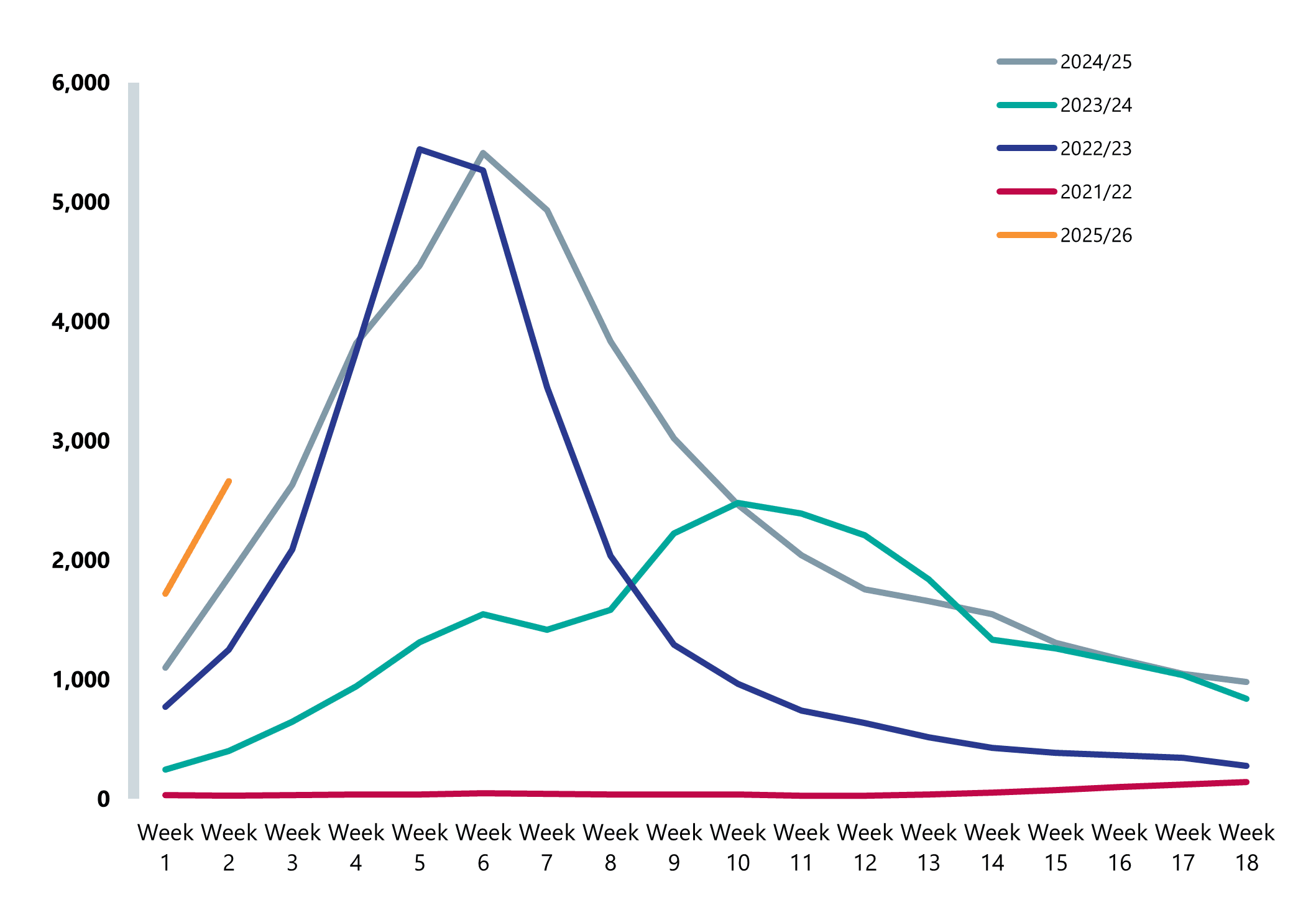
Flu: The first and second weeks of winter this year have seen record high flu figures. In the latest week, they climbed 55%, with 2,660 beds occupied on average each day by flu patients. This is 43% higher than last year.
RSV: Paediatric beds closed to RSV have increased by 10% over the first two weeks of winter to 95 on average each day. However, there were 11% fewer beds closed than the second week of winter last year.
D&V: The number of beds closed due to D&V and norovirus has risen by 41% over the first two weeks of winter 2025/26 to 447, on average, each day. But figures are consistently lower than last year (down 56% in the latest week).
Covid-19: The number of beds occupied by Covid-19 patients increased by 5% to 863 over the first two weeks of winter. Although, numbers are down from last year by a third (-36%) in the latest week.
Staff absences: The number of staff absences increased by 3% over the first two weeks of winter 2025/26, with on average 53,230 absences each day in the latest week. Of these, 1% were covid-19 related (276). Overall staff absences are broadly unchanged from last year, but covid-19 related absences remain considerably lower (-55%).
FIGURE 7
Average daily number of beds (general, acute and critical care) occupied by flu patients
Beds and occupancy
G&A beds: During the first two weeks of winter, Bed occupancy rates were consistently high, averaging 94% in week 1 and rising slightly to 94.3% in week 2. These rates remain above both the NICE 2018 guideline of 90% and the 2023/24 planning guidance target of 92%, although they were marginally lower than last year’s occupancy of 94.6% in the second week of winter. The average number of beds occupied increased from 95,550 in week 1 to 96,170 in week 2, reflecting a small rise in demand over the fortnight.
Critical care beds: During the first two weeks of winter, the average number of adult critical care beds increased from 78.1% to 80.9%. In the most recent week, the adult critical care bed occupancy rate was 2.8 percentage points higher than last year.
PICU occupancy: At the start of winter, PICU bed occupancy was lower than rates seen the same time last year. In the latest week, bed occupancy was 83.3%, lower than last year’s figure (85.2%).
NICU occupancy: NICU bed occupancy was slightly higher in the first two weeks of winter compared to last year. Occupancy was 70.6% this week, up from 69.6% over the same period last year.
Access and flow
As highlighted in our acute and ambulance section, urgent and emergency care services continue to experience high demand which is also reflected in the winter sitrep data:
A&E closures and diverts: So far this winter, patients were diverted to other A&E departments 94 times due to a lack of capacity, 32 occurrences more than this time last year. There have been no A&E closures so far this winter.
Ambulance arrivals: A total of 98,964 patients arrived at hospital by ambulance in the first week of December. This takes the total so far this winter to almost 200,000 patients - 5% higher than the same period last winter and a 11% more than two years ago.
Ambulance handovers: The mean handover time in increased across the first two weeks of winter to 37 minutes 51 seconds but was 5 minutes faster than last year. However, so far this winter 14% of ambulance handovers were over the maximum 45-minute ambulance handover time standard set out in the UEC plan.
Discharges: In the first week of December, 1 in 7 G&A hospital beds were occupied by patients medically fit to be discharged (13.5% of occupied hospital beds). On average this winter, 13,090 hospital beds per day were occupied by patients medically fit for discharge, equating to 183,300 bed days lost per week so far this winter, which is 8% more than last year. 57.5% of patients who were medically fit to be discharged at some point this winter remained in hospital longer than they needed to, an increase from 55% last year.